| Credit: | by Haas & Peale |
|---|---|
| Date: | 1863.09.08 |
| Negative Size: | 5 in. x 8 in. |
| Equipment: | flag; horse; Sibley tent; wall tent |
| Locations & Lines: | Charleston Harbor; Charleston SC; Morris Island SC; South Carolina |
| Military Units: | US Army; US Navy |
| Transports: | ironclad; monitor; rowboat; USS New Ironsides; USS Lehigh; USS Montauk; USS Nahant; USS Passaic; USS Patapsco |
| Sources: | Library of Congress |
$3.99
File Details: APRUm, 900 DPI, TIFF, Copy Negative, 32.4 Mb
SKU
e55dc1367e7f
Category Field Photographs
Tags by Haas & Peale, Charleston harbor, Charleston SC, flag, horse, ironclad, monitor, Morris Island SC, rowboat, Sibley tent, South Carolina, US Army, US Navy, USS Lehigh, USS Montauk, USS Nahant, USS New Ironsides, USS Passaic, USS Patapsco, wall tent
Image ID: APRU
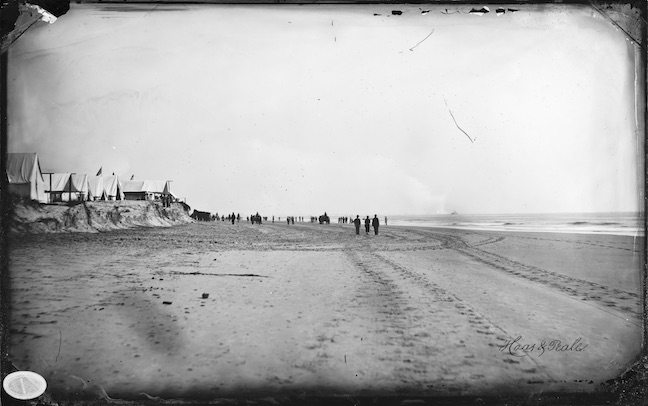
Library of Congress says: Morris Island, South Carolina. Unidentified camp. [Summary: Photo shows tents and soldiers on beach of Morris Island. In distance, ironclads, including USS New Ironsides and five monitor-class warships are in action against Fort Sumter and Fort Moultrie in Charleston harbor. (Source: 99 Historic Images of Civil War Charleston, ed. by Garry Adelman, John Richter, and Bob Zeller, Center for Civil War Photography, 2009, p. 18)]
Center for Civil War Photography says: A REAL COMBAT PHOTOGRAPH … the USS IRONSIDES ENGAGED IN ACTION NEAR CHARLESTON (by Craig Heberton)
Bob Zeller, author of the essential book “The Blue and Gray in Black and White” (2005), describes this 4 x 7 inch glass negative as what may be Union Army photographers Haas & Peale’s “single greatest photographic contribution to the visual history of the war [and which] was not recognized for what it was for more than 140 years … It wasn’t even published in a book until 2000.” Note that the images below are ALL cropped down from the negative.
Mr. Zeller points out that “more than fifty people are visible standing on the beach, but no one is facing the camera. All peer up the beach toward Charleston Harbor, riveted by the spectacle before them. Smoke erupts from the portside of the New Ironsides, hugs the surface of the water, and then arcs hundreds of feet into the sky. When Charleston historian Jack Thomson first saw this image some years ago, he immediately noticed the smoke and was drawn deeper into the scene … When Thomson had the image enlarged, he found the five monitors [the Passaic, Montauk, Nahant, Patapsco, and Lehigh], their smokestacks and distinctive cylindrical turrets clearly outlined at water level.”
Mr. Thomson opined after some research that the view was taken at maximum low tide, at about 10:00 a.m. on September 8, 1863. Therefore, it may have been taken very near in time to twin negative views taken by Charleston-based photographer George S. Cook of the ironclad action in Charleston Harbor on that same day. In which case, these “combat action photographs [may represent] the first battle in history to be captured by two cameras in two different places, representing both sides of the conflict.”
Haas & Peale No. 79.
Etched onto negative: 1.