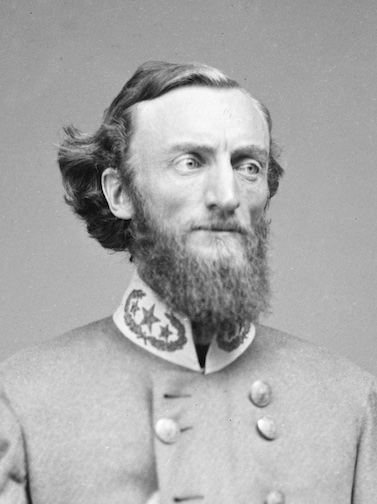
 Wikipedia says: John Sappington Marmaduke (March 14, 1833 – December 28, 1887) served as the 25th governor of Missouri from 1885 until his death in 1887. During the American Civil War, he was a senior officer of the Confederate States Army who commanded cavalry in the Trans-Mississippi Theater.
On September 6, 1863 Marmaduke killed Confederate Brigadier-General Lucius M. Walker in a duel. Major-General Sterling Price ordered Marmaduke’s arrest, but suspended the order because of the impending Union advance on Little Rock, Arkansas. Marmaduke never faced a court martial for the duel.
…Marmaduke was on duty in the New Mexico Territory in the spring of 1861 when he received news that Missouri had seceded from the Union. He returned home to meet with his father, a strong Unionist. Afterwards, Marmaduke decided to resign from the United States Army, effective April 1861. Pro-secession Missouri Governor Claiborne F. Jackson, Marmaduke’s uncle, soon appointed him as the colonel of the 1st Regiment of Rifles, a unit from Saline County, Missouri, in the Missouri State Guard.
Governor Jackson departed Jefferson City, Missouri in June, along with State Guard commander Major-General Sterling Price, to recruit more troops. Marmaduke and his regiment met them at Boonville, Missouri. Within a short time, Price and Jackson left, leaving Marmaduke in charge of a small force of militia. Marmaduke realized his troops were not adequately prepared for combat, but Governor Jackson ordered him to make a stand against Union forces who had entered the state. Federal Brigadier-General Nathaniel Lyon’s 1,700 well-trained and equipped soldiers easily routed Marmaduke’s untrained and poorly armed force at the Battle of Boonville on June 17, 1861. The skirmish was mockingly dubbed “the Boonville Races” by Unionists, since Marmaduke’s recruits broke and ran after 20 minutes of battle.
Disgusted by the situation, Marmaduke resigned his commission in the Missouri State Guard and traveled to Richmond, Virginia, where he was commissioned a first lieutenant in the regular Confederate States Army. The Confederate War Department ordered him to report for duty in Arkansas, where he soon was elected lieutenant-colonel of the 1st Arkansas Battalion. He served on the staff of Lieutenant-General William J. Hardee, a former United States Military Academy instructor of infantry tactics. Marmaduke’s former Mormon War commander, Albert Sidney Johnston, asked him to join his staff in early 1862. Marmaduke was wounded in action at the Battle of Shiloh as colonel of the 3rd Confederate Regiment, incapacitating him for several months.
In November 1862, the War Department confirmed Marmaduke’s promotion to brigadier-general. His first battle as a brigade commander was at the Battle of Prairie Grove. In April 1863, Marmaduke departed Arkansas with 5,000 men and ten artillery pieces and entered Union-held Missouri. However, he was repulsed at the Battle of Cape Girardeau and forced to return to Helena, Arkansas. Controversy soon followed. In September 1863, he accused his immediate superior officer, Brigadier-General Lucius M. Walker, of cowardice in action for not being present with his men on the battlefield. Walker, slighted by the insult, challenged Marmaduke to a duel, which resulted in Walker’s death on September 6, 1863.
Marmaduke later commanded a cavalry division in the Trans-Mississippi Department, serving in the Red River Campaign. While commanding a mixed force of Confederate troops, including Native-American soldiers of the 1st and 2nd Choctaw Regiments, Marmaduke defeated a Union foraging detachment at the Battle of Poison Spring, Arkansas on April 18, 1864. He was hailed in the Confederate press for what was publicized as a significant southern victory.
Marmaduke commanded a division in Major-General Sterling Price’s Raid September–October 1864 into Missouri, where Marmaduke was captured at the Battle of Mine Creek in Kansas (by Private James Dunlavy of the 3rd Iowa Cavalry). While still a prisoner of war at Johnson’s Island in Ohio, Marmaduke was promoted to major-general in March 1865. He was released after the war ended. His younger brother, Henry Hungerford Marmaduke, served in the Confederate States Navy, was captured and was imprisoned on Johnson’s Island. He later served the federal government in negotiations with South American nations. He is buried in Arlington National Cemetery. Two other Marmaduke brothers died in the American Civil War.
Showing all 4 resultsSorted by latest


