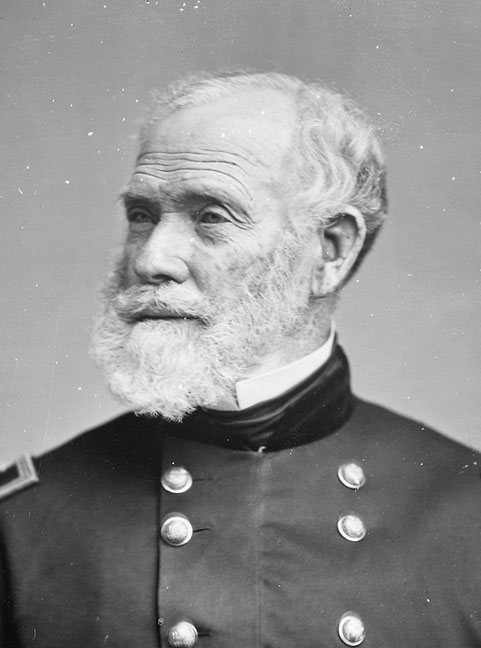
 Wikipedia says: William Selby Harney (August 22, 1800 – May 9, 1889) was a Tennessee-born cavalry officer in the US Army, who became known (and controversial) during the Indian Wars and the Mexican–American War. One of four general officers in the US Army at the beginning of the American Civil War, he was removed from overseeing the Department of the West because of his Confederate sympathies early in the war although he kept Missouri from joining the Confederacy. Under President Andrew Johnson, he served with on the Indian Peace Commission, negotiating several treaties before spending his retirement partly in St. Louis and partly trading reminiscences with Jefferson Davis and Ulysses S. Grant in Mississippi.
…As the Civil War began, Harney was still in command of the Army’s Department of the West based at Jefferson Barracks in St. Louis, Missouri, and his wife’s family was prominent in the area. General Twiggs accepted a Confederate commission to head the Department of Louisiana and was accordingly dismissed from the US Army and replaced by Edwin V. Sumner. Missouri Governor Claiborne Jackson was pro-secession, but the majority of Missourians favored Union. After the bombardment of Fort Sumter, President Abraham Lincoln called for troops to suppress the rebellion. Jackson refused and began plotting with Confederate authorities to bring about Missouri’s secession by a military coup.
On May 10, 1861, Captain Nathaniel Lyon, commander of the St. Louis Arsenal, led a force of unofficial Unionist “Home Guards” to capture a force of state militia that were poised to seize the Arsenal by acting without any authorization from Harney, his superior. The Camp Jackson Affair resulted in a bloody riot in St. Louis, which horrified Harney.
The state legislature responded by reorganizing the militia as the Missouri State Guard and authorizing it to resist an invasion by federal troops. Harney tried to calm the situation and agreed to the Price–Harney Truce with Guard Commander Sterling Price, who was married to Harney’s wife’s niece. They agreed that the State Guard would control most of Missouri while federal troops stayed near St. Louis. The deal also involved Missouri Governor Claiborne Jackson, who favored secession but swore allegiance to the Union.
That was not acceptable to Unionist leaders in Missouri, including the Republican leader Francis Preston Blair, Jr., since Price did nothing to prevent the organization of pro-Confederate forces or to protect Unionists in his territory. Worsening matters was Harney’s Tennessee heritage, which made his loyalty to the Union suspect. Blair reported all to the Lincoln administration in Washington, DC, and was authorized to replace Harney with Lyon, which Blair did on 30 May.
Recalled to Washington to discuss the situation, Harney was captured by Confederates at Harper’s Ferry on April 25, 1861. He was offered a command by Confederate General Robert E. Lee but turned down the offer. However, because he was a Tennessean, his captors graciously released him and allowed him to continue on to Washington.
Harney remained in Washington and served in various administrative positions. When it became clear that he would not receive another field command, he retired in 1863 and lived in St. Louis. In recognition of his long and distinguished career, he was awarded and breveted to major general in 1865.
Showing the single result
