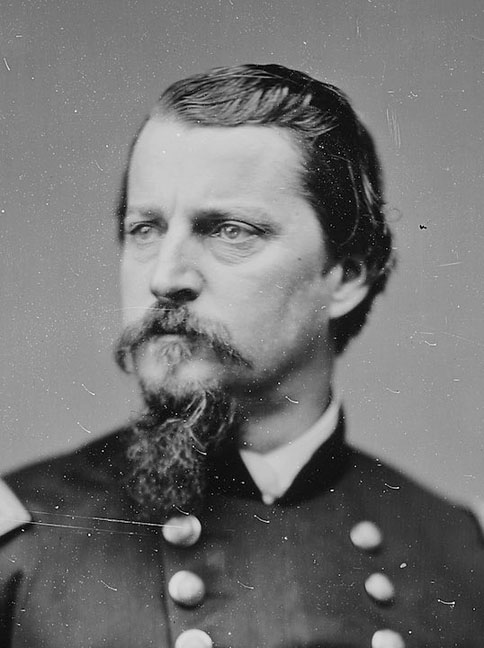
 Wikipedia says: Winfield Scott Hancock (February 14, 1824 – February 9, 1886) was a United States Army officer and the Democratic nominee for President of the United States in 1880. He served with distinction in the Army for four decades, including service in the Mexican–American War and as a Union general in the American Civil War. Known to his Army colleagues as “Hancock the Superb”, he was noted in particular for his personal leadership at the Battle of Gettysburg in 1863. His military service continued after the Civil War, as Hancock participated in the military Reconstruction of the South and the Army’s presence at the Western frontier.
Hancock’s reputation as a war hero at Gettysburg, combined with his status as a Unionist and supporter of states’ rights, made him a potential presidential candidate. When the Democrats nominated him for President in 1880, he ran a strong campaign, but was narrowly defeated by Republican James A. Garfield. Hancock’s last public service involved the oversight of President Ulysses S. Grant’s funeral procession in 1885…
Civil War
Joining the Army of the Potomac
Hancock stands the most conspicuous figure of all the general officers who did not exercise a separate command. He commanded a corps longer than any other one, and his name was never mentioned as having committed in battle a blunder for which he was responsible. He was a man of very conspicuous personal appearance…. His genial disposition made him friends, and his personal courage and his presence with his command in the thickest of the fight won for him the confidence of troops serving under him. No matter how hard the fight, the 2nd corps always felt that their commander was looking after them.
—Ulysses S. Grant, Personal Memoirs
Hancock returned east to assume quartermaster duties for the rapidly growing Union Army, but was quickly promoted to brigadier general on September 23, 1861, and given an infantry brigade to command in the division of Brig. Gen. William F. “Baldy” Smith, Army of the Potomac. He earned his “Superb” nickname in the Peninsula Campaign, in 1862, by leading a critical counterattack in the Battle of Williamsburg; army commander Maj. Gen. George B. McClellan telegraphed to Washington that “Hancock was superb today” and the appellation stuck. McClellan did not follow through on Hancock’s initiative, however, and Confederate forces were allowed to withdraw unmolested.
In the Battle of Antietam, Hancock assumed command of the 1st Division, II Corps, following the mortal wounding of Maj. Gen. Israel B. Richardson in the horrific fighting at “Bloody Lane”. Hancock and his staff made a dramatic entrance to the battlefield, galloping between his troops and the enemy, parallel to the Sunken Road. His men assumed that Hancock would order counterattacks against the exhausted Confederates, but he carried orders from McClellan to hold his position. He was promoted to major general of volunteers on November 29, 1862. He led his division in the disastrous attack on Marye’s Heights in the Battle of Fredericksburg the following month and was wounded in the abdomen. At the Battle of Chancellorsville, his division covered Maj. Gen. Joseph Hooker’s withdrawal and Hancock was wounded again. His corps commander, Maj. Gen. Darius N. Couch, transferred out of the Army of the Potomac in protest of actions Hooker took in the battle and Hancock assumed command of II Corps, which he would lead until shortly before the war’s end.
Gettysburg
Hancock’s most famous service was as a new corps commander at the Battle of Gettysburg, July 1 to 3, 1863. After his friend, Maj. Gen. John F. Reynolds, was killed early on July 1, Maj. Gen. George G. Meade, the new commander of the Army of the Potomac, sent Hancock ahead to take command of the units on the field and assess the situation. Hancock thus was in temporary command of the “left wing” of the army, consisting of the I, II, III, and XI Corps. This demonstrated Meade’s high confidence in him, because Hancock was not the most senior Union officer at Gettysburg at the time. Hancock and the more senior XI Corps commander, Maj. Gen. Oliver O. Howard, argued briefly about this command arrangement, but Hancock prevailed and he organized the Union defenses on Cemetery Hill as more numerous Confederate forces drove the I and XI Corps back through the town. He had the authority from Meade to withdraw, so he was responsible for the decision to stand and fight at Gettysburg. At the conclusion of the day’s action, Maj. Gen. Henry Warner Slocum arrived on the field and assumed command until Gen. Meade arrived after midnight.
On July 2, Hancock’s II Corps was positioned on Cemetery Ridge, roughly in the center of the Union line, while Confederate Gen. Robert E. Lee launched assaults on both ends of the line. On the Union left, Lt. Gen. James Longstreet’s assault smashed the III Corps and Hancock sent in his 1st Division, under Brig. Gen. John C. Caldwell, to reinforce the Union in the Wheatfield. As Lt. Gen. A.P. Hill’s corps continued the attack toward the Union center, Hancock rallied the defenses and rushed units to the critical spots. First, he sent the 3rd Brigade of the 3rd Division, under Col. George Willard, into the fray to stop the advance of Confederate Brigadier General William Barksdale’s Brigade. In one famous incident, he sacrificed a regiment, the 1st Minnesota Volunteer Infantry Regiment, by ordering it to advance and charge a Confederate brigade four times its size, causing the Minnesotans to suffer 87% casualties. While costly, this sacrifice bought time to organize the defensive line and saved the day for the Union Army. Following the action toward his right, he sent the 13th Vermont Volunteer Infantry Regiment of the 1st Corps, which had come from Cemetery Hill to help quell the crisis, to recover some artillery pieces the Confederates had captured and were pulling away. The Vermonters were successful. Having stabilized his line, he turned his attention to the sound of fighting on East Cemetery Hill. There, with darkness falling, Confederates from Maj. Gen. Jubal Early’s Division had gotten into Union batteries and were fighting the cannoneers hand-to-hand. Hancock sent the First Brigade of his Third Division, under Colonel Samuel S. Carroll, to the fighting. The brigade was crucial in flushing the enemy out of the batteries and dispatching them back down the face of East Cemetery Hill.
On July 3, Hancock defended his position on Cemetery Ridge and thus bore the brunt of Pickett’s Charge. During the massive Confederate artillery bombardment that preceded the infantry assault, Hancock was prominent on horseback, reviewing and encouraging his troops. When one of his subordinates protested, “General, the corps commander ought not to risk his life that way,” Hancock is said to have replied, “There are times when a corps commander’s life does not count.” During the infantry assault, his old friend, Brig. Gen. Lewis A. Armistead, now leading a brigade in Maj. Gen. George Pickett’s division, was wounded and died two days later. Hancock could not meet with his friend because he had just been wounded himself, a severe wound caused by a bullet striking the pommel of his saddle, entering his inner right thigh along with wood fragments and a large bent nail. Helped from his horse by aides, and with a tourniquet applied to stanch the bleeding, he removed the saddle nail himself and, mistaking its source, remarked wryly, “They must be hard up for ammunition when they throw such shot as that.” News of Armistead’s mortal wounding was brought to Hancock by a member of his staff, Capt. Henry H. Bingham. Despite his pain, Hancock refused evacuation to the rear until the battle was resolved. He had been an inspiration for his troops throughout the three-day battle. Hancock later received the thanks of the U.S. Congress for “… his gallant, meritorious and conspicuous share in that great and decisive victory.”
One military historian wrote, “No other Union general at Gettysburg dominated men by the sheer force of their presence more completely than Hancock.” As another wrote, “his tactical skill had won him the quick admiration of adversaries who had come to know him as the ‘Thunderbolt of the Army of the Potomac’.”
Virginia and the end of the war
Hancock suffered from the effects of his Gettysburg wound for the rest of the war. After recuperating in Norristown, he performed recruiting services over the winter and returned in the spring to field command of the II Corps for Lt. Gen. Ulysses S. Grant’s 1864 Overland Campaign, but he never regained full mobility and his former youthful energy. Nevertheless, he performed well at the Battle of the Wilderness and commanded a critical breakthrough assault of the Mule Shoe at the “Bloody Angle” in the Battle of Spotsylvania Court House on May 12, shattering the Confederate defenders in his front, including the Stonewall Brigade. His corps suffered enormous losses during a futile assault Grant ordered at Cold Harbor.
After Grant’s army slipped past Lee’s army to cross the James River, Hancock found himself in a position from which he might have ended the war. His corps arrived to support William Farrar Smith’s assaults on the lightly held Petersburg defensive lines, but he deferred to Smith’s advice because Smith knew the ground and had been on the field all day, and no significant assaults were made before the Confederate lines were reinforced. One of the great opportunities of the war was lost. After his corps participated in the assaults at Deep Bottom, Hancock was promoted to brigadier general in the regular army, effective August 12, 1864.
Hancock’s only significant military defeat occurred during the siege of Petersburg. His II Corps moved south of the city, along the Wilmington and Weldon Railroad, tearing up track. On August 25, Confederate Maj. Gen. Henry Heth attacked and overran the faulty Union position at Reams’s Station, shattering the II Corps, capturing many prisoners. Despite a later victory at Hatcher’s Run, the humiliation of Reams’s Station contributed, along with the lingering effects of his Gettysburg wound, to his decision to give up field command in November. He left the II Corps after a year in which it had suffered over 40,000 casualties, but had achieved significant military victories. His next assignment was to command the ceremonial First Veteran Corps. He performed more recruiting, commanded the Middle Department, and relieved Maj. Gen. Philip Sheridan in command of forces in the now-quiet Shenandoah Valley. He was promoted to brevet major general in the regular army for his service at Spotsylvania, effective March 13, 1865.
Post-war military service
Execution of Lincoln assassination conspirators
At the close of the war, Hancock was assigned to supervise the execution of the conspirators in the assassination of President Abraham Lincoln. Lincoln had been assassinated on April 14, 1865, and by May 9 of that year, a military commission had been convened to try the accused. The actual assassin, John Wilkes Booth, was already dead, but the trial of his co-conspirators proceeded quickly, resulting in convictions. President Andrew Johnson ordered the executions to be carried out on July 7. Although he was reluctant to execute some of the less-culpable conspirators, especially Mary Surratt, Hancock carried out his orders, later writing that “every soldier was bound to act as I did under similar circumstances.”
Showing all 6 resultsSorted by latest
-

Image ID: 2BVW
$2.99 -

Image ID: AZQM
$2.99 -
Image ID: AICS
Price range: $0.99 through $2.99 This product has multiple variants. The options may be chosen on the product page -

Image ID: AQSP
Price range: $0.99 through $3.99 This product has multiple variants. The options may be chosen on the product page -

Image ID: AKSN
$2.99 -
Image ID: AMJJ
$2.99 This product has multiple variants. The options may be chosen on the product page