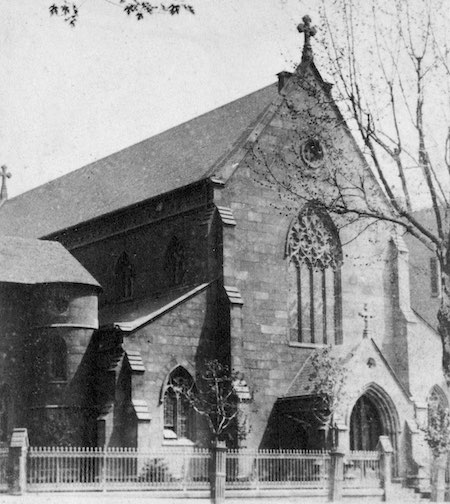
 Wikipedia says: Grace & St. Peter’s Church is an Anglo-Catholic Episcopal parish in the city of Baltimore, in the Episcopal Diocese of Maryland. The congregation is the product of the 1912 amalgamation of two earlier parishes, St. Peter’s Church (founded in 1803) and Grace Church (founded in 1850). Its building, constructed in Brownstone, is an elaborate example of English Gothic Revival architecture dating from 1852.
History
St. Peter’s Church (1803–1911)
Founded in 1802, St. Peter’s Church was the second-oldest Episcopal congregation in the city after Old Saint Paul’s (1692). The organizing vestry received a charter from the city of Baltimore “to solicit and receive subscriptions and donations, not exceeding twenty-five thousand dollars for the purpose of purchasing a lot of land […] for the building [of] a Protestant Episcopal church, to be called St. Peter’s.” The first building, on Sharp and German Streets was consecrated May 27, 1804 by Bishop Claggett, and occupied until June 28, 1868.
Grace Church (1850–1911)
Grace Church began its ministry as a mission parish of St. Peter’s, at the encouragement of Bishop Whittingham. Organized on February 15 and incorporated on May 30, 1850, the new Grace Church was designed by John Rudolph Niernsee and James Crawford Neilson, and situated at the corner of West Monument Street and Park Avenue. On July 20, 1850, The Rev. Thomas Atkinson, Rector of St. Peter’s laid the cornerstone of the new church. Atkinson left St. Peter’s to take charge of Grace Church, but within a year was elected Bishop of North Carolina. Atkinson was succeeded by The Rev. Arthur Cleveland Coxe (later Bishop of Western New York). Educated at the General Theological Seminary, Coxe brought High church sympathies to Grace and inaugurated a trend toward Anglo-Catholicism that continues in the parish today.
Nearly a decade long, Coxe’s incumbency (1854–1863) was successful but still marked by internal divisions and controversy: during the American Civil War, Grace Church, like many white Maryland parishes, had divided loyalties. Tensions were especially high during the Union occupation of the city, and in one – possibly apocryphal – incident, a “prominent society woman […] haughtily and publicly rebuked an usher for ‘daring to seat’ a Federal officer in her pew” at Grace.
Showing the single result